A pattern-based scan found copied project histories paired with frequently refreshed README links to ZIP files that were detected as Trojans after download.
Windows Latest measured an approximately 10-second delay in Microsoft’s WebView2-based app, while Outlook Classic displayed the selected message almost immediately.
A Scientific American account traces cancelled grants, agency departures and political restrictions through the collapse of a proposed NASA x-ray mission.
Experiments on a 2022 M2 Mac suggest newer compact models can handle bounded agentic work, though speed, context and production reliability remain constraints.
A reverse-engineering project found a potential physical-access route to execute code on a 2021 Civic’s infotainment system, though its reach across models remains unconfirmed.
The browser-driven tool snapshots pages after they load, downloads their supporting assets and can package a mirror as a ZIM file or standalone viewer.
A new interface-design essay says polished endpoints are not enough when moving elements become misaligned, misleading or visually incoherent during transitions.
A privacy researcher says removing randomized disclosure controls from Census Bureau and economic releases will not eliminate the underlying trade-off between confidentiality and usefulness.
An operator reportedly incurred a $6,531.30 AWS charge after an AI agent prepared high-capacity infrastructure for repeated scans of a hobbyist network.
Niantic Spatial’s work with defense contractor Vantor has renewed scrutiny of how player-contributed scans helped develop visual positioning technology.
A server-led application with progressive enhancement reportedly reached users missed by a previous client-heavy implementation and preserved incomplete sessions for later return.
A temporary injunction over false allegations against two publishers rejects the idea that generated summaries receive the same limited liability treatment as ordinary search links.




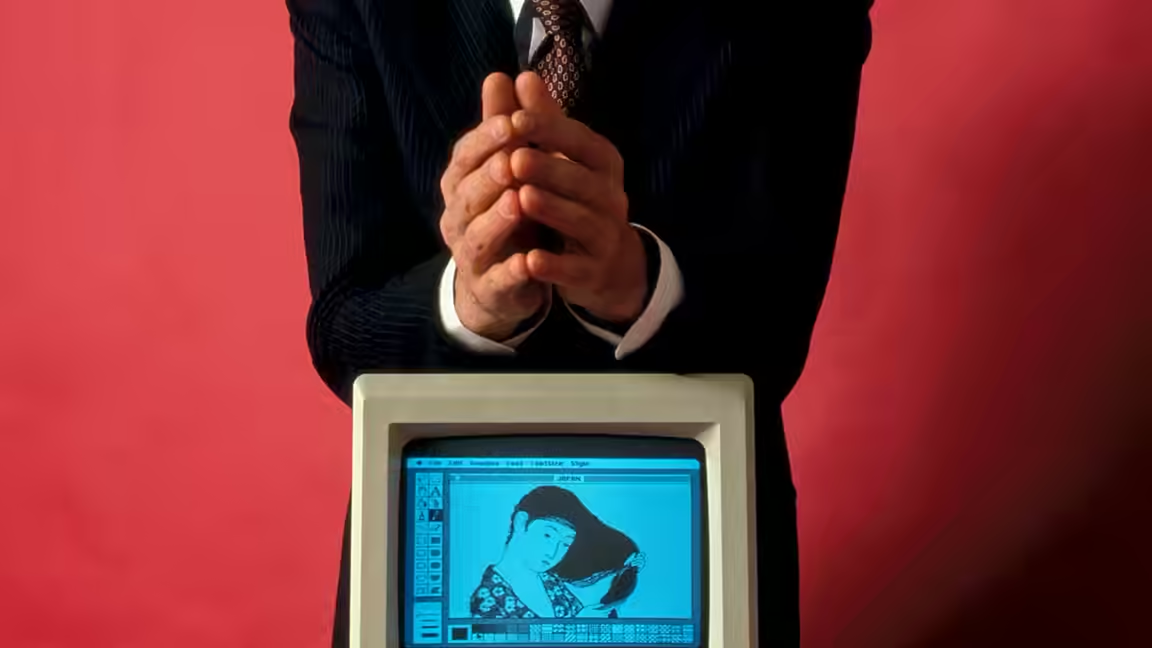


![Steve Jobs and Macintosh computer, January 1984, by Bernard Gotfryd. The image on the computer screen is 髪梳ける女 (A Woman Combing Her Hair) [ media ], by Hashiguchi Goyo (d. 1921).…](/media/articles/commons-0b9f87c8f97c.avif)