Water sets a ceiling on settlement
Lunar polar ice could support bases and small towns for centuries, but it is unlikely to sustain cities of one million people without new supplies or major advances in recycling, according to an analysis highlighted by Frontiers on September 14. Researchers Martin Elvis and Jonathan McDowell examined how long settlements could operate using estimated local water reserves under different population and recycling assumptions.
Their most optimistic scenario begins with one billion tonnes of accessible water and assumes recycling efficiency of 98%, comparable to the rate cited for the International Space Station. Even under those favourable conditions, a city with one million residents would exhaust the resource in just over 100 years. Without recycling, the same population would use it within a few years.
The outlook becomes tighter when the authors apply lower estimates. Frontiers says current best estimates of lunar water are roughly 30 times smaller than the generous upper bound used in the model. At that level, even a relatively small city could run dry after about a decade. A settlement of 1,000 people, or a town of 10,000, would place far less pressure on the reserve and could potentially operate for several centuries.
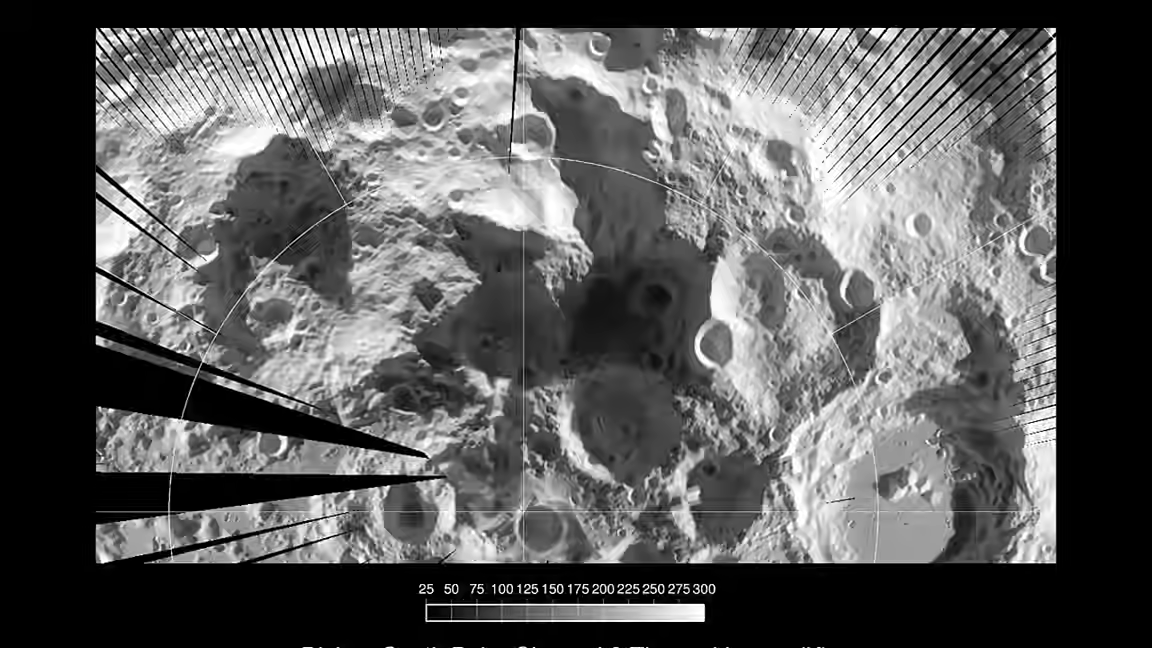
Water is concentrated in permanently shadowed craters near the Moon's poles. Their floors have avoided direct sunlight for billions of years and can remain colder than 110 kelvin, allowing delivered water to persist as ice rather than escaping into space. Orbiting missions have mapped likely deposits, but present survey techniques generally probe only the upper few metres. The deeper regolith may contain additional reserves that have not yet been measured.
Energy looks easier than water
The analysis treats electricity as a more manageable constraint. Crater rims near the frozen deposits receive sunlight for long periods, creating potential sites for photovoltaic generation. The researchers estimate that kilometre-high structures covered with solar arrays could produce about three gigawatts, and note that the Moon contains silicon that might eventually support local panel manufacturing.
That contrast is important for proposals involving industry or computing infrastructure on the Moon. Abundant solar generation would not remove the need for water used by people, food production and industrial processes. A large settlement would still depend on exceptionally efficient recovery systems and confidence that ice can be extracted at the quantities assumed.
The authors identify several possible responses: cut demand through methods such as vertical farming, improve recycling by several times, import water from accessible asteroids, or locate substantially more ice below the surface. Each would add engineering complexity and, in the case of imported supplies, a continuing logistics requirement.
The work is a feasibility estimate rather than a completed survey of lunar resources. Its result therefore does not rule out human settlements. It instead separates the comparatively plausible prospect of bases and modest towns from visions of self-sustaining metropolitan populations. Before plans for lunar cities can be treated as durable, the analysis suggests that missions must establish how much usable water exists, how difficult it is to extract and how closely future settlements can approach a closed water cycle.